Afro Hair Transplant in Istanbul, Turkey is a hair restoration procedure designed for tightly curled and coiled hair types where the follicles often curve beneath the skin. Because Afro–curly grafts can be more delicate during extraction and placement, the plan, tools, and technique may need extra precision to help protect graft integrity and preserve a natural curl pattern.
If you want a clear, realistic plan for your curl type, you can start with an online case review with ClinMedica to understand candidacy, technique options, and the likely timeline.
What is Afro Hair Transplant in Istanbul, Turkey?
An Afro hair transplant is a cosmetic procedure that may help restore hair in areas affected by thinning or baldness using grafts taken from your own donor area.
- What makes Afro–curly hair unique is not only the visible curl, but the way many follicles curve or coil beneath the scalp, which can make extraction and implantation more technically demanding than with straighter hair types.
- Many people with tightly curled hair (often described as 4A, 4B, or 4C) have follicles that can bend below the surface. This means the team must pay close attention to angle, depth, and rotation during extraction to reduce the risk of graft damage.
- When planning is done carefully, transplanted hair usually keeps the characteristics of the donor area—so the curl pattern commonly returns as growth progresses.
Why Is Afro–Curly Hair More Delicate to Transplant?
- Afro–curly grafts may be more prone to damage during extraction because the follicle can curve beneath the skin rather than follow a straighter path. If the extraction angle doesn’t match that curve, the graft may be partially cut or stressed, which can affect growth.
- Another practical difference is visual: the curl pattern often provides stronger coverage and can help hide signs of transplantation, but only if the placement respects the natural direction and rotation of the curl.
- A generic approach can lead to awkward lift, texture mismatch, or a hairline that looks too sharp for the patient’s natural pattern.
Best Technique for Afro Hair: How FUE and Sapphire Are Often Combined?
FUE hair transplant in Istanbul is primarily an extraction method (how grafts are taken from the donor area). “Sapphire” commonly describes how channels are created for implantation using sapphire blades. DHI in Istanbul commonly refers to implantation using a pen-like implanter.
Because Afro follicles can be tightly coiled, some implantation tools can be more challenging to use with very curved grafts. That does not mean one method is always wrong, but it does mean technique selection should be based on your curl pattern, graft shape, and the team’s proven workflow for textured hair. At ClinMedica, Afro cases are commonly approached with:
- FUE to extract grafts
- Sapphire blade channel creation to prepare recipient sites
- Careful placement of grafts into channels to control angle and direction
In some patients with very tightly coiled follicles, manual FUE may be considered to increase control during extraction and help reduce graft stress—because the operator can adjust angle and depth with more tactile precision.
Technique Comparison for Afro–Curly Hair (Practical View)
The table below is designed to help you understand what each method tends to be used for in Afro Hair Transplant in Istanbul, Turkey. The best choice depends on your follicle curvature, donor quality, and the team’s experience.
| Method / Step | What it’s used for | Potential advantages in Afro hair | Practical limitations / notes |
|---|---|---|---|
| FUE (Extraction) | Removing grafts from donor area | Commonly used; can be adapted with careful angle control | In coiled follicles, needs slower, precise angle matching to reduce graft stress |
| Manual FUE (Extraction) | Removing grafts with high tactile control | May improve precision in very curved follicles | Often more time-consuming and technique-dependent |
| Sapphire blade channels (Implantation preparation) | Creating recipient channels | May allow controlled channel creation and planned direction | Still requires skilled placement to match curl orientation |
| DHI-style implantation (Pen implanter) | Implanting grafts using a pen tool | Can offer angle control in some cases and areas | For very coiled grafts, loading/handling may be challenging; suitability varies by curl tightness |
Do You Need a Specialist for Afro Hair Transplantation?
Afro hair transplantation is often considered more complex than straight-hair transplants because the follicles may curve beneath the scalp. This is why surgeon oversight, team experience, and a consistent workflow matter—especially for graft handling and placement direction.
A safer way to evaluate a clinic is to focus on process clarity, not marketing claims. You want a clinic that can explain how they:
- assess follicle curvature and donor capacity
- adapt extraction angle and depth
- protect the donor area for future needs
- design a hairline that suits Afro textures
- plan for realistic density without overharvesting
Who Is a Good Candidate for Afro Hair Transplant in Istanbul, Turkey?
Afro Hair Transplant in Istanbul, Turkey may help people with thinning hair or localized baldness, but candidacy depends on donor supply, scalp condition, and realistic expectations. You may be a reasonable candidate if you have:
- Stable donor density in the back/sides
- Thinning at the hairline, temples, or crown
- A clear goal for hairline shape and coverage
- Willingness to follow aftercare instructions consistently
It may be safer to pause or delay surgery if you are having:
- An active scalp infection or inflammation
- An ongoing scarring alopecia that is not stable
- A history of abnormal scarring (such as raised scars) that needs medical discussion
- A very limited donor density that may not support your goals safely
Afro Hairline Design: Edges, Temples, and Natural Density Planning
In textured hair, design matters as much as technique. A natural hairline usually avoids an unnaturally sharp “straight wall” effect. Many Afro hairlines look more natural with subtle irregularity and a shape that fits facial proportions and age.
Edges and traction-related thinning
Some patients—especially those with long-term tension from tight styles—experience thinning at the edges or temples. In these cases, planning may need extra care because the skin can be more sensitive and donor resources must be protected. Afro Hair Transplant in Istanbul, Turkey may help in selected cases, but the key question is whether the scalp is stable and not actively inflamed.
Density planning that looks natural
Afro hair often provides the appearance of fuller coverage because curl and thickness can create volume. That can be an advantage—but only when density is placed strategically. A practical plan often uses:
- softer density at the very front for a natural transition
- stronger density behind the hairline to build fullness
- angle and direction that match natural curl flow
Afro Hair Transplant Procedure Step by Step
A clear process reduces stress and helps you prepare. While details vary by clinic and patient, a structured Afro case usually follows a consistent path from assessment to follow-up. The list below shows where your most important decisions happen—hairline design, extraction control, and placement direction.
- Send photos for assessment: donor area + thinning areas in good light and multiple angles.
- Discuss goals and limits: hairline shape, coverage priorities, and donor capacity.
- Confirm technique plan: extraction approach (FUE/manual FUE as needed) and implantation workflow (often sapphire channel creation + placement).
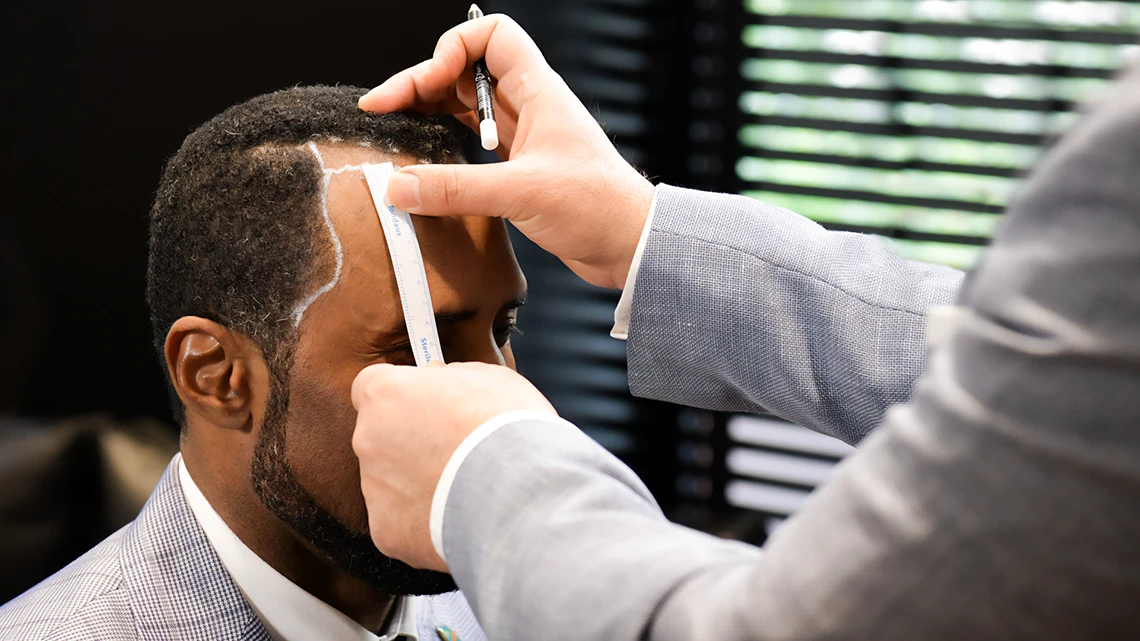
- Hairline design on procedure day: final adjustments based on facial structure and curl behavior.
- Extraction phase: careful angle/depth control to protect coiled follicles.
- Implantation phase: channel direction and placement aligned with natural curl orientation.
- First wash and aftercare guidance: instructions that protect grafts in the early phase.
- Follow-up schedule: check-ins to monitor healing and early growth stages.
Recovery Timeline: What to Expect Week by Week
After an Afro hair transplant, mild redness and tenderness can occur early. In many patients with darker skin tones, redness may be less noticeable—but healing still follows the same biological stages. Scabs typically loosen as the surface heals, while follicles remain under the skin. A typical timeline often looks like this:
- Days 1–10: mild swelling/tightness may occur; scabs form and begin to settle.
- Around 2 weeks: scabs gradually fall away; the scalp looks calmer.
- Weeks 4–6: “shock loss” may occur (temporary shedding of transplanted hairs).
- Months 3–4: early regrowth may begin; texture can look uneven at first.
- Months 6–9: density often becomes more noticeable.
- Months 9–12: maturation continues; curl pattern typically becomes clearer.
Results: Curl Pattern, Coverage, and What Natural Means
Many patients ask whether an Afro hair transplant changes curl type. Because grafts are taken from your own donor area, the hair commonly retains its original characteristics. Early growth can appear different—sometimes looser or irregular—before the curl pattern stabilizes over time.
Afro hair’s natural thickness and curl can create a fuller appearance, but outcomes still depend on several factors, including:
- donor density and graft quality
- extraction precision (protecting curved follicles)
- placement angle and direction
- healing and aftercare adherence
- progression of native hair loss over time
A realistic goal is a result that looks natural in everyday lighting and styling—not a “perfect” or guaranteed density level.
Why Choose ClinMedica for Afro Hair Transplant Planning?
ClinMedica’s approach focuses on matching technique to curl behavior and donor health—because Afro follicles often require careful angle control and gentle graft handling. The priority is a plan that respects:
- coiled follicle anatomy beneath the skin
- natural direction and rotation of curls
- conservative donor management for long-term needs
- clear recovery guidance and warning signs
What it costs at ClinMedica
An Afro hair transplant costs €2,850 with the Sapphire FUE package or €3,550 with the DHI package at ClinMedica, both for the maximum number of grafts. Each package includes the doctor's consultation and hairline design, a translator, transfers, two nights in a hotel, blood tests, needle-free local anesthesia, the medicines and aftercare products, and AGF and PRP injections. Every price is on the hair transplant prices page.
FAQs About Afro Hair Transplant in Istanbul, Turkey
Will my curl pattern change after transplant?
In many cases, the curl pattern remains the same because transplanted follicles come from your own donor area and usually keep their characteristics. Early growth may look irregular or less defined while follicles settle and mature. If you notice severe redness, increasing pain, or discharge during healing, seek medical help promptly.
Is DHI suitable for Afro–curly hair?
DHI-style implantation may be used in some clinics for certain zones, but with very tightly coiled grafts it can be more challenging to handle and load follicles without stressing them. Many teams prefer workflows that allow careful channel planning and placement control. The safest choice depends on your curl tightness, donor quality, and the clinic’s proven method.
When will I see growth after the shedding phase?
Temporary shedding can happen in the first month or two. Many patients begin noticing early regrowth around months 3–4, with clearer density developing later. Because curls coil, progress can feel slower visually at first. Worsening swelling, fever, or pus-like discharge are not typical and should be assessed urgently.
How long until I see the final results?
Final maturation often continues through months 9–12, and sometimes longer depending on individual healing and growth speed. Texture definition can improve gradually as hair thickens and the curl pattern settles. Results vary, and no clinic should promise a specific density outcome for every patient.
What are the main risks I should know?
Short-term effects can include redness, swelling, tenderness, itching, and temporary pimples during growth. Some patients with darker skin tones may be more prone to pigment changes if aftercare isn’t followed carefully, and those with a history of raised scarring should discuss risks in advance. Seek urgent care for fever, worsening pain, spreading redness, or discharge.
Conclusion: Afro Hair Transplant in Istanbul, Turkey
In the end, Afro Hair Transplant in Istanbul, Turkey can be a natural-looking option for restoring coverage when it’s planned around coiled follicle anatomy, careful extraction, and curl-respecting placement. Many patients notice early regrowth around months 3–4, while visible density commonly improves through months 6–9 and continues maturing toward 12 months—though timelines vary by healing and donor factors.
- Focus on curl-safe extraction and gentle graft handling
- Choose hairline design that matches Afro texture and facial proportions
- Expect shock loss and gradual regrowth rather than instant change
- Follow aftercare closely to protect early healing
- Prioritize donor preservation for long-term needs
If you’re ready for a realistic plan, contact us at ClinMedica to review your case, with clear photos and goals so the team can guide the safest next step.
Medical Disclaimer:
This article was medically reviewed by our surgeons at ClinMedica, including our medical staff. It is intended for informational purposes only and does not replace a professional medical consultation.
Learn more about how we create and review our content by visiting our Content Policy.