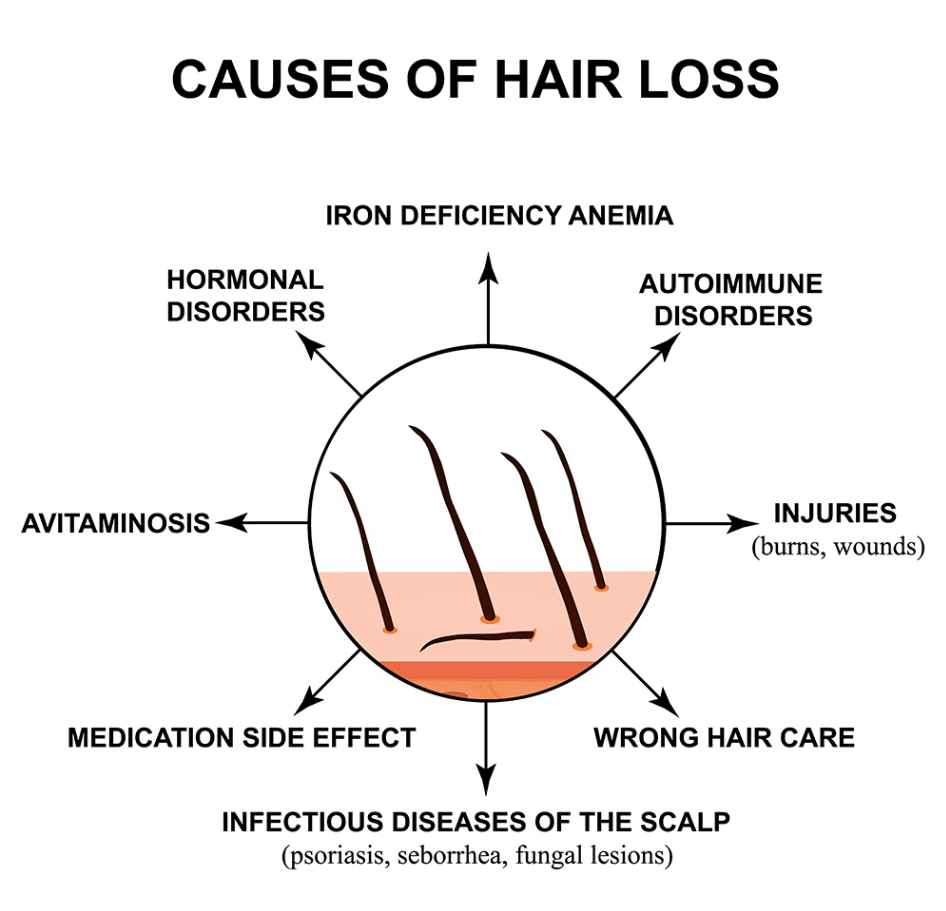
Causes of hair loss are a complex biological phenomenon and a clinical symptom of various internal and external disruptions. At ClinMedica, we analyze hair thinning through a medical lens to ensure every diagnosis is based on scientific evidence.
We believe that successful restoration starts with education, as an informed patient is a successful patient. This guide examines the primary causes of hair loss—ranging from genetic predispositions to the lifestyle factors that compromise hair density and health.
Understanding the Causes of Hair Loss within the Biological Life Cycle
To truly grasp the various causes of hair loss, one must first understand the intricate way hair grows. Every follicle on the human scalp functions as an independent organ, following a precise three-phase cycle.
The first stage is the Anagen Phase, which can last anywhere from two to seven years. Under healthy conditions, approximately 85% to 90% of your scalp hair is in this stage. However, many causes of hair loss act by prematurely cutting this growth phase short. The second stage is the Catagen Phase, a brief two-week period where the follicle begins to shrink and detaches from the dermal papilla, the vital blood supply that provides nutrients.
Finally, the Telogen Phase lasts around three to four months. In this stage, the hair “rests” before eventually falling out to make room for a new shaft. The pathology of thinning occurs when this cycle is disrupted; for instance, in genetic balding, the Anagen phase becomes progressively shorter with each cycle, a phenomenon known as Follicular Miniaturization.
Genetic Predisposition and the Biological Causes of Hair Loss
Androgenetic Alopecia remains the primary driver of hair thinning on a global scale, affecting more than 50% of the male population by the age of 50, as well as millions of women. This condition is not merely a cosmetic concern but a complex biological process rooted in a hereditary sensitivity to specific androgens.
Male Pattern Baldness and the Mechanism of DHT
In men, the fundamental catalyst among the biological causes of hair loss is Dihydrotestosterone (DHT), a potent derivative of testosterone. For individuals with a genetic predisposition, DHT binds to androgen receptors within the scalp’s follicles.
This interaction triggers a process known as follicular miniaturization, where the hair growth cycle is systematically shortened. Over time, the follicles produce hair shafts that are progressively thinner, shorter, and less pigmented. Eventually, the follicle may cease to produce visible hair entirely. This progression is clinically categorized using the Norwood Scale, typically initiating with a receding hairline at the temples before advancing toward the crown.
Female Pattern Baldness and Hormonal Fluctuations
Women experience the biological causes of hair loss through a distinct clinical presentation known as Diffuse Thinning. Unlike the localized bald spots seen in men, female pattern hair loss involves a general decrease in density across the entire scalp.
This condition is frequently intensified by significant hormonal shifts, such as those occurring during menopause or as a result of Polycystic Ovary Syndrome (PCOS). Estrogen plays a protective role in maintaining the hair’s growth phase (Anagen); when estrogen levels decline or androgen influence increases, the hair’s “part line” begins to widen, and the structural integrity of the hair volume diminishes.
Stress Induced Physiological Causes of Hair Loss
Stress is a profound physiological trigger. When the human body undergoes a significant shock, it enters a “survival mode,” prioritizing vital organs and diverting nutrients away from hair production. This is medically known as Telogen Effluvium, one of the most common acute causes of hair loss.
During a sudden shock ranging from high fever to extreme emotional trauma, the body can prematurely push up to 30% of active follicles into the resting phase. A critical aspect of these causes of hair loss is the delay; shedding does not occur immediately but typically manifests three to four months later. Fortunately, once the underlying stressor is resolved, the follicles return to the growth phase, though achieving full density can take up to a year.
Lifestyle Factors and Nutritional Causes of Hair Loss
The health of your scalp’s micro-environment is a direct reflection of your lifestyle. Modern life introduces several environmental causes of hair loss that can be managed with the right intervention, such as our PRP Therapy which focuses on bio-stimulation.
The Impact of Alcohol and Chronic Dehydration
While alcohol does not trigger balding directly, it creates a “hostile environment” for growth. Alcohol acts as a diuretic, leading to systemic dehydration. Since the hair shaft is composed of 25% water, chronic dehydration makes the hair brittle and prone to breakage. Furthermore, alcohol interferes with the absorption of Zinc and Iron, which are essential for keratin production.
Nutritional Bioavailability and Mineral Deficiencies
The hair follicle is one of the most metabolically active tissues in the body. Therefore, nutritional gaps are significant causes of hair loss.
- Iron and Ferritin: Low iron levels are the primary cause of thinning in women, as iron is required to carry oxygen to the hair roots.
- Protein: Hair is made of Keratin. A low-protein diet leads to structural weakness and premature shedding.
Autoimmune Diseases and Inflammatory Hair LossCauses
In some scenarios, the immune system becomes one of the primary causes of hair loss. In Alopecia Areata, the body’s T-cells mistakenly attack the hair bulb, resulting in the sudden appearance of smooth bald patches.
Not all causes of hair loss are internal; Traction Alopecia is caused by physical stress from tight hairstyles like braids or extensions. If the constant pulling continues, it leads to permanent scarring. Once the follicle is replaced by scar tissue, the loss becomes permanent, which is why early intervention is vital.
Comprehensive Comparison of Hair Loss Types
| Feature | Androgenetic Alopecia | Telogen Effluvium | Alopecia Areata | Traction Alopecia |
|---|---|---|---|---|
| Primary Cause | Genetics & DHT | Systemic Stress / Shock | Autoimmune Response | Physical Pulling |
| Rate of Loss | Very Gradual (Years) | Sudden (Delayed) | Rapid (Days/Weeks) | Gradual |
| Pattern | Temples & Crown | General Thinning | Smooth Round Patches | Along Hairline |
| Regrowth | Needs Clinical Treatment | High Potential (Natural) | Variable | Low if Scarred |
| Best Solution | Hair Transplant | Stress Management | Medical Consult | Changing Hairstyles |
This table is for general clinical guidance. Accurate diagnosis requires a professional consultation at ClinMedica.
Medical Interventions for the Various Causes of Hair Loss
Addressing the causes of hair loss depends on an accurate clinical diagnosis. At ClinMedica, we offer tailored treatments for each pathology:
- Pharmacological Solutions: Medications like Minoxidil and Finasteride are gold standards for managing genetic causes of hair loss.
* This table is for general clinical guidance. Accurate diagnosis requires a professional consultation at ClinMedica.
- Regenerative Therapy: Our PRP treatments utilize growth factors from the patient’s own blood to “wake up” dormant follicles.
- Long-Term Restoration: For advanced cases, FUE and DHI hair transplants give a long-lasting result by moving healthy, DHT-resistant follicles to the affected areas.
A professional evaluation is the only way to distinguish between the various causes of hair loss. Our clinical process includes Digital Trichoscopy, using a digital microscope to examine the scalp for miniaturization. We also perform Blood Panel Analysis to screen for Ferritin and Thyroid hormones, ensuring no metabolic factors are overlooked.
Conclusion for Taking Control of Your Hair Health
Understanding the specific causes of hair loss is a journey that no one should walk alone. Whether your thinning is driven by stress, nutrition, or genetics, there is always a medically-backed path forward. At ClinMedica, we specialize in identifying these triggers and providing lasting treatment to restore your hair and your confidence.
Medical Disclaimer:
This article was medically reviewed by our surgeons at ClinMedica, including our medical staff. It is intended for informational purposes only and does not replace a professional medical consultation.
Learn more about how we create and review our content by visiting our Content Policy.