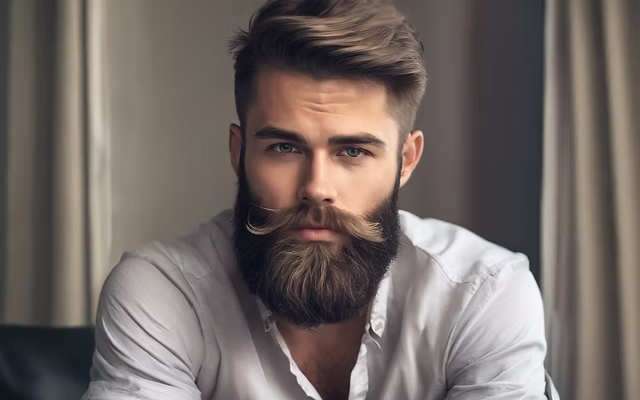
A Beard and Mustache Transplant in Turkey may help you restore patchy facial hair, improve definition, or cover gaps caused by genetics, scars, burns, or certain skin conditions. While keeping the result aligned with natural hair direction and facial balance.
At ClinMedica, the focus is a design-led plan: the beard line, density, and angles are customized to your face rather than applied as a generic template. If your goal is a specific look—light stubble, fuller cheeks, a stronger goatee, or a more defined mustache, we can help you start with a personalized assessment and a clear timeline for what happens next.
Beard and Mustache Transplant in Istanbul, Turkey
A Beard and Mustache Transplant in Istanbul is a facial hair restoration procedure that transfers healthy hair follicles from a donor area to the beard and/or mustache. The aim is to build a natural pattern by controlling angle, direction, and density so the result looks consistent in real life and in close-up photos. This service may be suitable if you want to:
- Fill patchy areas that never fully grew in (often genetic)
- Increase density to make styling easier
- Define a beard line that fits your face
- Cover gaps caused by scars or burns when the skin is suitable
- Improve mustache fullness or balance asymmetry
Why beard and mustache growth can be weak or patchy?
Facial hair growth varies widely between individuals, and the causes of weak or absent beard/mustache growth can differ.
Common causes
- Genetics: inherited density patterns and patchiness
- Hormonal factors: sometimes linked to androgen levels or follicle sensitivity (varies by individual)
- Skin conditions: such as alopecia areata or fungal issues that may create patchy loss
- Scars, burns, wounds: may disrupt growth in specific zones
- Nutrient deficiencies: such as low vitamin D or certain B vitamins, which may affect overall hair quality
- Chronic stress: may contribute to shedding or imbalance in some people
In many of these scenarios, a Beard and Mustache Transplant in Istanbul, Turkey may be considered when the donor area is healthy and the facial area is suitable for implantation.
Is a beard and mustache transplant right for you?
Not everyone is an ideal candidate immediately. The goal is to choose the safest route to a natural-looking result. You may be a good candidate if you have:
- Stable patchiness or long-standing thin density
- A healthy donor area at the back of the scalp
- Clear, realistic goals (shape + coverage, not “instant perfection”)
- No active infection or uncontrolled skin inflammation in the beard area
You may need evaluation before proceeding if you have
- Sudden new patches that are spreading
- Persistent redness, scaling, or infection signs in the beard region
- A history of problematic scarring (discuss your history during assessment)
- Medical conditions or medications that could affect bleeding or healing (this should be reviewed clinically)
What happens during your consultation?
The consultation is designed to reduce uncertainty and align expectations. During your consultation, the team typically focuses on:
- Your target style: full beard, goatee, mustache, cheek filling, or patch repair
- Facial balance: designing a beard line that enhances your features
- Current growth mapping: density distribution and hair direction
- Donor assessment: hair quality and availability in the back of the scalp
- Medical review: history, medications, and any skin issues
- A realistic timeline: what you can expect month by month
How Beard and Mustache Transplant in Turkey procedure works?
A beard and mustache transplant follows the principles of scalp hair transplantation—but facial hair requires more precision because angles and direction are highly visible.
Step-by-step overview
- Beard line and style design
You and the surgeon agree on the outline, transitions, and density priorities. - Local anesthesia
Local anesthesia is used to support comfort during extraction and implantation. - Graft extraction from the donor area
Grafts are typically taken from the back of the scalp (between the ears). - Graft sorting (single and double grafts)
Facial hair often looks most natural when built primarily with single-hair and two-hair grafts. - Graft preservation
Extracted grafts are kept in a specialized holding solution to maintain viability until implantation. - Implantation into beard/mustache
Angle, direction, and density are controlled to match natural growth patterns.
Why graft selection matters for natural facial hair
Beard hair behaves differently than scalp hair in how it grows and how density looks on the face. ClinMedica’s method emphasizes:
- Single-hair grafts for refined zones and natural transitions
- Two-hair grafts where more density is appropriate without looking unnatural
- Avoiding higher hair-count grafts in facial zones that could create an artificial appearance
This graft strategy supports realistic texture—especially in mustache borders and cheek gradients.
Sapphire blades vs DHI Choi pen for beard transplantation
Both techniques can be used in beard and mustache transplantation. The best option often depends on your skin, your density target, and the zones being treated.
Sapphire blade channel method
- Tiny channels are created first using sapphire blades
- Grafts are then placed into those channels
- Direction and angle are planned carefully during channel creation
DHI (Direct Hair Implantation) with Choi pen
- Grafts are implanted using a pen device
- Often preferred for facial zones where direction control is critical
- May help reduce trauma in some cases and support tighter control of placement
| Factor | Sapphire Channel Method | DHI (Choi Pen) |
|---|---|---|
| Best for | Broad coverage with structured channel planning | High-precision direction and density control |
| Placement control | High (depends on technique execution) | Very high (implanter-assisted control) |
| Facial sensitivity | Varies by skin type | Often chosen for delicate facial zones |
| Healing experience | Varies | May feel smoother for some patients |
How Far Below The Jawline Can Hair Be Transplanted?
This point matters for both safety and aesthetics. Many patients ask for extensive neck coverage. Our Clinic’s guidance emphasizes that:
- The area directly below the jawline may have thinner, softer skin.
- In appropriate cases, transplantation may extend up to a maximum of 1.5 cm below the jawline when the skin is suitable and there are no prominent superficial vessels.
- Transplantation below this point is often discouraged due to higher risk of poor graft stability and complications such as infection.
- A safe beard design typically prioritizes the jawline as the lower boundary, with limited extension only when medically appropriate.
Recovery after a Beard and Mustache Transplant in Istanbul, Turkey
Facial skin can be more reactive than the scalp, so it’s normal to see:
- Redness (often more noticeable on the face)
- Mild swelling or tenderness
- Crusting/scabs around implanted grafts
- Itching during healing in some people
First 14 days: the most important aftercare rules
The early period helps protect graft stability and reduce irritation.
Do
- Rest and keep your face protected from bumps and friction
- Follow washing instructions exactly as provided by your medical team
- Sleep with your head slightly elevated if advised
- Use only approved products recommended by the clinic
- Monitor your skin for unusual swelling, heat, or discharge
Avoid
- Touching, rubbing, or scratching the implanted area
- Heavy exercise and sweating early on if advised
- Direct sun exposure on the treated area
- Smoking or alcohol if your medical team advises avoidance due to healing concerns
- Using non-recommended creams/chemicals on the face during early healing
Shedding and regrowth: what’s normal?
Like scalp transplantation, beard and mustache transplants often go through a temporary shedding phase:
- Transplanted hairs may shed after the procedure while follicles remain under the skin
- Regrowth often begins around the third month
- Density improves gradually month by month
This stage can be emotionally frustrating, but it is commonly expected. New growth usually becomes more noticeable as the follicles re-enter a normal growth cycle.
Results from a beard and mustache transplant in Istanbul, Turkey?
Beard hair can mature faster than scalp hair in many cases, but timelines still vary. A realistic progression often looks like this:
- Days 1–10: redness and sensitivity gradually settle
- Weeks 2–8: shedding may occur while follicles stay in place
- Around month 3: early regrowth can begin
- Months 4–6: density improves progressively
- Months 6–9: many patients see a mature cosmetic outcome. (Some individuals may take longer to reach their final look.)
What influences the cost of a beard transplant in Turkey
Cost expectations can vary across countries. Based on the ClinMedica model provided:
- The procedure is generally approached as a package rather than priced strictly per graft.
- Technique choice (Sapphire vs DHI) may affect the overall plan.
- Case complexity (patches vs scars, zone count, design demands) can influence the final scope.
- Package structures may include logistical support and post-operative follow-up.
What it costs at ClinMedica
A beard transplant costs €2,850 with the Sapphire FUE package or €3,550 with the DHI package at ClinMedica, both for the maximum number of grafts. Each package includes the doctor's consultation and hairline design, a translator, transfers, two nights in a hotel, blood tests, needle-free local anesthesia, the medicines and aftercare products, and AGF and PRP injections. Every price is on the hair transplant prices page.
FAQs about Beard and Mustache Transplant in Istanbul, Turkey
Does a beard and mustache transplant look natural?
It often can—when graft type, direction, and density match natural facial hair growth. Design and angle control matter as much as graft number. If you have sudden expanding patches or active inflammation, it may be better to evaluate the cause first.
Does the Beard and Mustache Transplant hurt?
Local anesthesia is typically used to reduce discomfort. Sensitivity afterward can happen, especially on the face, and usually improves gradually. Severe, worsening pain or signs of infection should be assessed promptly.
Will transplanted beard hair fall out?
Temporary shedding is common and may happen in the first weeks, while follicles remain in place. New growth often begins later, commonly around the third month. If you see pus, fever, or rapidly spreading redness, seek care urgently.
How long does the procedure take?
Timing depends on the size of the area and the number of grafts required. Beard work can vary by zone (mustache vs full beard vs patch repair). Your consultation plan is the best way to estimate duration safely.
How do you decide between DHI and Sapphire for facial hair?
It depends on your skin sensitivity, target density, and the specific zones being restored. DHI may be preferred when direction control is crucial, while Sapphire channel work may suit broader structured coverage. A zone-by-zone plan is usually most reliable.
How many grafts might I need for a mustache vs a full beard?
It depends on your existing density, the shape you want, and whether you’re filling patches or building broader coverage. A mustache often needs fewer grafts than full cheeks and jawline work, but the final plan should be based on facial mapping and donor assessment.
When can I shave after a beard transplant?
Shaving timelines vary. Some patients may be advised to wait around 10 days or longer before shaving, and it’s often safest to follow clinic-specific instructions—especially for the mustache and border zones where friction can irritate healing skin.
When can I travel back or return to work?
It depends on your healing and how reactive your skin is. Many people can return to light daily activities relatively soon, but it’s wise to confirm your travel and work plan with us so early aftercare steps are not rushed.
Why our clinic for beard and mustache transplant in Istanbul, Turkey?
Choosing a clinic for facial hair restoration is not only about a technique name—it’s about planning and precision. Our approach emphasizes:
- Collaborative beard design based on facial structure and style goals
- Facial-appropriate graft selection (single and double graft focus)
- Controlled implantation for natural direction and density
- Clear safety boundaries for jawline/neck placement
- A structured patient journey designed for international visitors
Conclusion about Mustache and Beard Transplant in Istanbul, Turkey
In the end, Beard and Mustache Transplant in Istanbul, Turkey may help restore density, symmetry, and definition when patchiness, scars, or weak growth affect your facial hair. Results typically develop gradually, and temporary shedding can be part of the normal cycle—so the safest approach is a realistic timeline, careful aftercare, and clear warning-sign awareness.
- Choose design-first planning to avoid unnatural borders.
- Prioritize direction control for mustache and cheek transitions.
- Respect jawline limits for safety and stability.
- Expect gradual growth rather than instant density.
- Act quickly on warning signs such as fever, pus, or rapidly spreading redness.
For a personalized plan and the next practical steps, contact ClinMedica for a case review.
Medical Disclaimer:
This article was medically reviewed by our surgeons at ClinMedica, including our medical staff. It is intended for informational purposes only and does not replace a professional medical consultation.
Learn more about how we create and review our content by visiting our Content Policy.