
Tummy Tuck in Istanbul may help improve abdominal shape when loose skin, stretched muscles, or persistent fullness remain after pregnancy, weight changes, or aging. Also called abdominoplasty in Istanbul, Turkey, this procedure is designed to remove excess skin, tighten the abdominal wall when needed, and create a firmer, smoother midsection for selected patients.
Many people consider this surgery after they realize the issue is not only fat. In many cases, the main concern is skin laxity, muscle separation, or a lower abdominal fold that does not respond well to exercise alone. At ClinMedica, the goal is to help patients understand what the procedure may improve, what it does not change, and how to plan recovery in a safe and realistic way.
What Can a Tummy Tuck Help With?
Tummy Tuck in Istanbul is usually considered when the abdomen has changed in a way that lifestyle measures alone may not fully correct. This often includes loose hanging skin, a protruding lower abdomen, stretched tissues after pregnancy, or weakness in the abdominal wall after major weight loss. The procedure may help improve contour, support, and clothing fit, but it is not a weight-loss treatment.
A tummy tuck may help with:
- Excess abdominal skin after pregnancy or weight loss
- Skin folds that rub or feel uncomfortable
- A lower abdominal bulge linked to muscle separation
- A softer or less supported abdominal wall
- A waistline that looks uneven because of loose skin
- Contour concerns that liposuction alone may not fully address
A tummy tuck does not replace healthy habits. It also does not prevent future pregnancy, weight gain, or aging from changing the body again. That is why timing and candidacy matter as much as the operation itself.
Why People Choose Tummy Tuck in Istanbul
For many international patients, the decision is not only about the surgery. It is also about finding a practical care pathway for consultation, procedure planning, recovery, and follow-up. Tummy Tuck in Istanbul often appeals to patients who want a focused treatment plan for abdominal contouring while also understanding what travel and healing may involve.
Some patients are mainly bothered by loose skin after childbirth. Others have lost a large amount of weight and feel that the abdomen no longer matches the rest of their progress. Some notice that their clothes sit awkwardly, their core feels less supported, or their lower abdomen still projects despite consistent effort. In these situations, abdominoplasty in Istanbul, Turkey may be discussed as a structural contouring procedure rather than a cosmetic shortcut.
A careful consultation is still essential. The same appearance concern may come from different causes in different patients. One person may need skin removal and muscle repair. Another may be better suited to liposuction alone. A third may need to delay surgery until weight and lifestyle are more stable.
What Does Abdominoplasty Actually Change?
A tummy tuck is often described as a body contouring procedure, but that phrase can sound vague. In practice, the operation usually addresses three different issues: excess skin, abdominal wall laxity, and localized fat that affects contour. Not every patient has all three, and that is one reason why the treatment plan varies.
When abdominal muscles separate, usually after pregnancy or major stretching, the midsection may feel softer and look more projected. This is often called diastasis recti, which means the paired abdominal muscles have moved apart in the midline. In selected patients, repairing this separation may help create a flatter profile and a more supported core.
At the same time, excess skin may hang below the navel, fold over a scar, or create irritation in the lower abdomen. If the issue is mainly skin laxity, removing skin may make a bigger difference than removing fat. That distinction matters because liposuction and tummy tuck do not solve the same problem, even when they are sometimes combined.
Who May Be a Good Candidate for Abdominoplasty in Istanbul, Turkey?
Not everyone with abdominal fullness needs a tummy tuck. The strongest candidates are usually those who are seeking contour improvement after changes the body has not reversed on its own. They are often close to a stable weight, understand that scars are part of the trade-off, and are ready for a recovery period that lasts weeks rather than days.
You may be a good candidate if you:
- Have loose abdominal skin after pregnancy or weight loss
- Notice a lower abdominal bulge or suspected muscle separation
- Are close to a stable, sustainable weight
- Do not smoke, or are prepared to stop as advised
- Understand that healing takes time and scars are expected
- Are well enough for surgery and follow-up
- Are not planning pregnancy in the near future
You may need to postpone surgery if you:
- Are still actively losing weight
- Plan pregnancy soon
- Have uncontrolled medical conditions
- Cannot commit to early recovery support
- Expect the procedure to replace weight management
This part of the process is important because timing often affects satisfaction. If your weight is still changing, or if your daily routine will not allow proper healing, waiting may support a safer and more stable result.
Which Type of Tummy Tuck May Suit You?
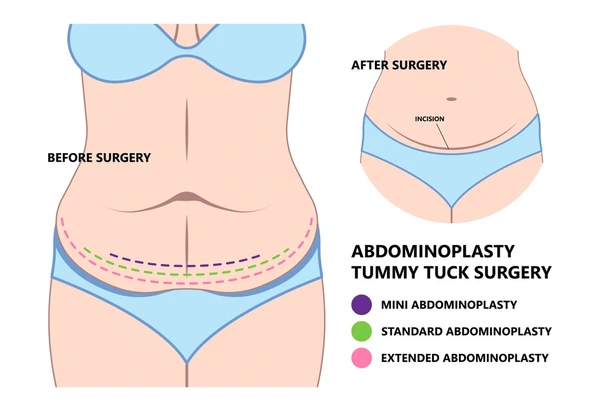
The right procedure depends on where the skin laxity sits, whether the muscles need repair, and how much contour change is needed. A useful way to think about it is not which procedure sounds best, but which one matches your anatomy.
| Type | May Suit Patients Who Have | Main Features | Recovery Notes |
|---|---|---|---|
| Mini tummy tuck | Mild excess below the belly button | Shorter incision, limited lower abdominal correction, usually no belly button repositioning | Often somewhat shorter recovery |
| Full tummy tuck | Loose skin above and below the navel with muscle separation | Wider skin removal, abdominal wall repair, belly button repositioning | More involved recovery than mini |
| Extended tummy tuck | Laxity that reaches toward the flanks | Longer incision and broader contouring | Longer healing window |
| Fleur-de-lis tummy tuck | Major skin excess vertically and horizontally, often after major weight loss | Horizontal plus vertical scar for greater skin removal | More extensive scar pattern and recovery |
| Tummy tuck with liposuction | Skin laxity plus surrounding contour concerns | Combines skin removal with selected fat reduction | Depends on extent and safety planning |
Mini tummy tuck
A mini tummy tuck is often considered when the concern is limited mainly to the lower abdomen below the belly button. It may suit patients with a lower abdominal pouch, mild skin excess, and less extensive muscle laxity. The incision is usually shorter, and belly button repositioning is often not required.
Full tummy tuck
A full tummy tuck is more appropriate when laxity extends above and below the navel or when muscle separation needs a more complete repair. This approach usually includes a low abdominal incision, tightening of the abdominal wall, removal of excess skin, and repositioning of the belly button to maintain a natural look.
Extended or fleur-de-lis tummy tuck
After significant weight loss, the skin may be loose not only up and down, but also across the width of the abdomen and into the flanks. In such cases, an extended or fleur-de-lis approach may be discussed. These options allow more skin removal, but they also involve more extensive scars and a longer recovery process.
Tummy tuck with liposuction
Liposuction may be added to improve the waistline, flanks, or upper abdomen in selected patients. This can refine transitions and shape, but it still needs careful planning. More treatment is not always better. Safety, skin quality, and healing capacity all influence whether combining procedures is advisable.
Tummy Tuck vs Liposuction: What Is the Difference?
This question comes up often because both procedures relate to abdominal shape, but they solve different problems. Liposuction mainly removes fat. A tummy tuck mainly removes loose skin and may repair separated abdominal muscles. If the main issue is a skin fold or abdominal wall laxity, liposuction alone may not create the result the patient expects.
A simple comparison may help:
- Choose liposuction thinking when the main issue is localized fat with good skin elasticity
- Consider tummy tuck thinking when the main issue is loose skin or muscle separation
- Consider a combined approach only when anatomy and safety support it
This difference is important because many disappointed outcomes begin with the wrong procedure choice, not poor healing. A detailed evaluation may help clarify whether the problem is fat, skin, support, or a combination.
What Happens Before, During, and After Surgery?
Many patients feel more comfortable once they understand the process as a sequence rather than a single event. Abdominoplasty in Istanbul, Turkey usually involves planning, pre-operative review, the operation itself, early monitored recovery, and then a longer healing phase that continues after the first days.
Before surgery
Before surgery, the team typically reviews medical history, medications, smoking status, previous operations, and patient goals. Pre-operative tests may be needed depending on the case. Patients are often advised about fasting, stopping certain supplements or blood-thinning medications if medically appropriate, and preparing practical support for the first recovery phase.
This is also the right time to discuss scars, drains, compression garments, travel timing, and what help will be needed with daily movement. Clear questions before surgery often reduce stress after surgery.
During surgery
The procedure is commonly performed under general anesthesia. A low incision is usually made on the abdomen so the scar may be concealed by many underwear or swimwear styles. If muscle separation is present, it may be repaired using sutures to support the abdominal wall. Excess skin is then removed, and the remaining skin is redraped for a smoother contour. In many full tummy tucks, the belly button is brought through a new opening at a natural position.
After surgery
Dressings, compression support, and sometimes drains may be used. Swelling, bruising, tightness, and limited comfort with upright posture are common early on. Gentle walking is often encouraged as soon as appropriate because it may support circulation and reduce certain risks linked to immobility.
How Long Should You Stay in Istanbul for a Tummy Tuck?
For international patients, the stay should support safe planning rather than rushed travel. The exact timeline depends on the procedure, the pace of early healing, and whether drains are used. In many cases, patients benefit from staying long enough for early follow-up, wound review, and movement to become more manageable before flying.
This question matters because leaving too early may transfer stress to the recovery phase instead of reducing it. The first week often includes swelling changes, drain checks if present, garment adjustment, and practical guidance on movement and comfort. These are not small details. They are part of the treatment journey itself.
When planning accommodation, patients often benefit from thinking in practical terms rather than luxury terms. Easy bathroom access, an elevator, a calm environment, and minimal transport strain may be more useful than a more distant stay with extra amenities.
Tummy Tuck Recovery in Istanbul: What Should You Expect?
Tummy Tuck in Istanbul recovery usually begins with a period of tightness, swelling, and careful movement. Many patients describe the early feeling more as pressure and stiffness than sharp pain, although discomfort levels vary. Recovery tends to feel easier when patients prepare for limited mobility, rest strategically, and follow aftercare instructions closely.
A general recovery pattern may look like this:
Days 1 to 3
The first days are often the most restrictive. Walking is usually slow and supported. Standing fully upright may feel uncomfortable. Compression garments are commonly used, and drains may still be in place. Hydration, short walks, rest, and medication instructions all matter during this phase.
Days 4 to 7
Patients often feel slightly steadier, though the abdomen still feels tight and swollen. Walking becomes easier, but pacing is important. Some people are tempted to do too much once they feel a little better. That can be unhelpful. Gentle progression is usually safer than early overconfidence.
Weeks 2 to 4
By this stage, many patients are moving more independently. Some desk-based work may feel manageable depending on discomfort, energy, and medical guidance. Swelling usually remains present, even when the body looks more defined than before. Compression garments often continue during this period.
Weeks 6 to 12
Light activity often increases gradually after medical clearance. Tightness may still come and go. Scar care becomes more relevant, and the shape may continue refining as swelling settles. Patients should still avoid assuming that “feeling better” means “fully healed.”
Several months later
Final settling takes time. Scars may soften and lighten gradually, and residual swelling may continue to improve over several months. This is one reason why early results and final results should not be judged as the same thing.
What Should You Prepare Before Travel and Recovery?
Good preparation may make recovery smoother and reduce unnecessary stress. Patients often focus on the surgery itself and underestimate how much the first week depends on practical planning.
Before travel, it may help to prepare:
- Loose, easy-to-wear clothing
- Slip-on shoes
- Light bags that do not require lifting
- A place to rest with easy bathroom access
- Support for the first several days
- A clear understanding of medication instructions
- Copies of medical notes and contact details
- Time away from demanding work or childcare lifting
A patient who prepares for healing usually feels more in control than one who prepares only for the procedure day.
What Results May Improve, and What Will Not Change?
This is one of the most important sections for realistic expectations. Tummy Tuck in Istanbul may help create a flatter abdominal contour, a firmer waistline transition, better clothing fit, and a more supported midsection in selected patients. When muscle repair is part of the plan, some people also feel that their core seems more stable during standing and daily movement.
What may improve:
- Lower abdominal overhang
- Loose skin after pregnancy or weight loss
- A softer abdominal wall when muscles are repaired
- The way clothes sit across the midsection
- The contour between abdomen and pubic area
- Some lower abdominal stretch marks if they are on the removed skin
What will not change completely:
- Natural bone structure or torso width
- The need for healthy habits after surgery
- Every stretch mark on the abdomen
- The possibility of future body changes from pregnancy or weight fluctuation
- The fact that scars are permanent, even if they usually improve over time
A helpful mindset is to think in terms of improvement rather than reinvention. The best candidates often want their body to feel more aligned with the effort they have already made, not transformed into something unrealistic.
What Risks and Warning Signs Should You Know?
Every surgery carries risk. A tummy tuck may involve risks such as bleeding, infection, delayed wound healing, seroma, asymmetry, temporary numbness, scar concerns, and anesthesia-related complications. Risk level depends on overall health, smoking status, surgical extent, and recovery planning.
Warning signs that need urgent medical attention include:
- Shortness of breath
- Chest pain
- Heavy bleeding
- Rapidly increasing swelling
- High fever
- Redness spreading around the incision
- Foul-smelling drainage
- Severe pain that is worsening rather than improving
- One-sided leg swelling or pain
- Wound opening or darkening of the skin edges
These symptoms do not always mean a serious complication is present, but they should never be ignored. Prompt assessment is important. If symptoms are sudden, intense, or affect breathing or circulation, urgent medical help should be sought immediately.
Why Realistic Timing Matters
One of the most overlooked parts of abdominoplasty in Istanbul, Turkey is timing. Surgery may be technically possible at many points, but “possible” and “well-timed” are not always the same. Patients usually do best when they are weight-stable, finished with near-term pregnancy plans, and able to protect a proper recovery window.
Rushing into surgery while weight is still changing, while smoking continues, or while there is no plan for help after surgery may increase stress and affect healing. In contrast, patients who choose the right time often find the recovery more manageable and the result more durable.
If you are still deciding, a useful next step is not to ask only, “Do I want this surgery?” A more practical question is, “Am I in the right phase of life and health for this surgery now?” That shift often leads to a better decision.
What it costs at ClinMedica
A tummy tuck costs €4,300 at ClinMedica. The package includes the doctor's consultation, 2 nights under medical observation after the operation, 7 nights' stay in Istanbul, the medicines for recovery, transportation, the compression garment and a translator. Every procedure price is on the plastic surgery price list.
Frequently Asked Questions About Tummy Tuck in Istanbul
How do I know whether I need a mini or full tummy tuck?
A mini tummy tuck may suit patients whose concern is limited mainly to the lower abdomen below the belly button. A full tummy tuck is more often considered when loose skin and muscle separation extend above and below the navel. The right choice depends on skin laxity, muscle condition, and contour goals rather than preference alone.
How long should I stay in Istanbul after a tummy tuck?
The ideal stay depends on the procedure and early healing progress. Many international patients benefit from staying long enough for early recovery checks, drain management if needed, and practical movement support before flying home. Rushing travel too early may make the first phase of healing more stressful and less comfortable.
When can I fly after tummy tuck surgery?
Flight timing depends on your healing progress, the extent of surgery, and medical clearance. Patients are usually advised not to treat travel as a small detail because swelling, drains, mobility, and clot prevention all matter. A treating team should advise when travel is appropriate based on the individual case.
Will a tummy tuck help me lose weight?
A tummy tuck is not considered a weight-loss procedure. Some tissue is removed, but the main purpose is contour improvement through skin removal and abdominal wall support when needed. It may help the abdomen look flatter and feel firmer, but it does not replace long-term weight management habits.
How visible are tummy tuck scars?
Scars are an expected part of the procedure. Surgeons usually aim to place the main scar low on the abdomen so it may be hidden by many underwear or swimwear styles. The final appearance depends on the type of procedure, healing pattern, skin characteristics, and scar care over time.
Can tummy tuck surgery be combined with liposuction?
Sometimes yes. In selected patients, liposuction may be added to refine the waist or nearby areas. Whether combination treatment is appropriate depends on anatomy, blood supply considerations, the extent of surgery, and overall safety planning. More treatment is not automatically better treatment.
When should I seek medical help during recovery?
You should seek prompt medical advice if you develop fever, worsening redness, foul drainage, increasing swelling, heavy bleeding, chest pain, shortness of breath, severe pain, or one-sided leg swelling. If symptoms are sudden or severe, urgent medical help is important right away.
Conclusion: Is Tummy Tuck in Istanbul the Right Next Step?
In the end, Tummy Tuck in Istanbul may help patients who are dealing with loose abdominal skin, a lower abdominal fold, or weakened abdominal support after pregnancy, weight changes, or aging. It may improve contour, comfort, and clothing fit in selected cases, but it works best when expectations are realistic and the recovery period is taken seriously.
Quick recap:
- A tummy tuck mainly treats loose skin and abdominal wall laxity
- It is not a substitute for weight loss
- Mini, full, and extended options suit different body patterns
- Recovery takes planning, patience, and follow-up
- Chest pain, shortness of breath, heavy bleeding, or high fever need urgent medical attention
If you are considering abdominoplasty in Istanbul, Turkey, ClinMedica may help you understand whether this procedure matches your anatomy, timing, and goals. This content is educational and should not replace personalized medical advice, diagnosis, or treatment planning.
Medical Disclaimer:
This article was medically reviewed by our surgeons at ClinMedica, including our medical staff. It is intended for informational purposes only and does not replace a professional medical consultation.
Learn more about how we create and review our content by visiting our Content Policy.