
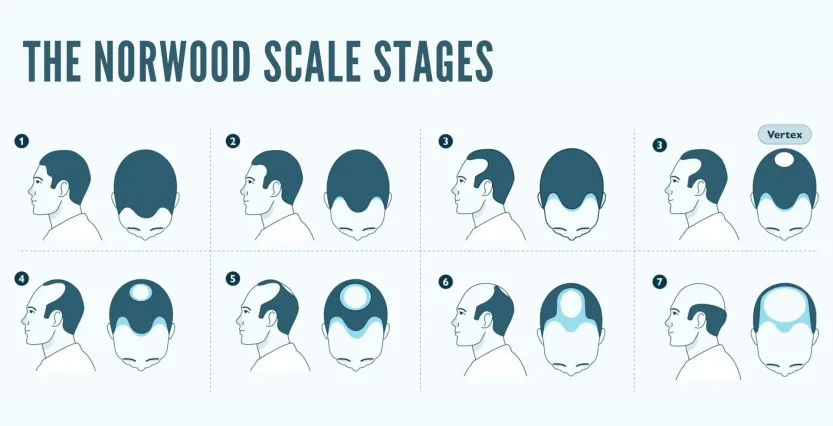
The Norwood Scale in Turkey Istanbul is the internationally recognized classification system used by specialists to measure the seven stages of male pattern baldness. It provides a diagnostic roadmap that helps ClinMedica determine the severity of hair loss and the most effective restoration strategy.
Understanding your placement on the Hamilton-Norwood Scale is a critical first step for any man considering a hair transplant. Whether you are noticing the early signs of a receding hairline or managing advanced thinning, this scale ensures that both the patient and the surgical team share a common visual language.
The Scientific Evolution of the Norwood Scale in Turkey
The Norwood Hair Scale did not emerge in a vacuum. It is the result of decades of clinical observation aimed at bringing precision to the study of androgenic alopecia. Originally, Dr. James Hamilton studied over 700 individuals in 1951 to categorize hair loss into “bald” and “non-bald” groups. However, his system lacked the nuance required for modern surgical planning.
In 1975, Dr. O’Tar Norwood refined this research by studying 1,000 men. He removed the vague “Type III basket criteria” and added more specific stages of progression. This modern Norwood classification system is now the gold standard because it accurately reflects how dihydrotestosterone (DHT levels) affects hair follicles over time.
Detailed Breakdown of the Norwood Hair Scale Stages
Each stage of the Norwood Scale in Istanbul represents a specific level of miniaturization. Understanding these levels helps manage expectations regarding coverage and Hair density.
Norwood Stage 1: The Juvenile Hairline
Key Characteristics:
- A full, straight, or slightly rounded hairline.
- No visible recession at the temples or thinning at the crown.
- Total scalp coverage with high density.
Stage 1 is the baseline of a “juvenile” hairline. It is not considered balding. However, it is the ideal time to establish a family history profile. If male pattern baldness runs in your family, monitoring for subtle changes at this stage may help in early preventative care.

Norwood Stage 2: The Hairline Maturation
Key Characteristics:
- Slight, symmetrical recession at the temples.
- The hairline takes on a subtle “M” shape.
- No thinning is present at the vertex (crown).
It is crucial to differentiate between a “mature hairline” and early balding. Most men transition from a juvenile to an adult hairline in their 20s. This is a natural aging process and may not require surgical intervention.

Norwood Stage 3: The Clinical Turning Point
Key Characteristics:
- Deep recession at the temples forming a distinct M, U, or V shape.
- The recession is deep enough to be considered “clinically bald.”
- Stage 3 Vertex: Early thinning at the crown may accompany the frontal recession.
Stage 3 is often when hair loss becomes cosmetically noticeable to others. For many men, this is the stage where they begin researching the Norwood Scale in Istanbul for surgical options.
- Graft Count: 1,000 to 2,500 grafts.
- Goal: Restoring the frontal frame and reinforcing the temples.

Norwood Stage 4: Advanced Frontal and Vertex Thinning
Key Characteristics:
- Severe recession at the temples.
- A clearly visible bald spot at the vertex.
- A solid “bridge” of hair still separates the front from the crown.
At Stage 4, the hair loss is undeniable. While the bridge remains, it may show signs of narrowing. This is a highly successful stage for hair transplantation because there is usually an abundance of donor hair available at the back of the head.

Norwood Stage 5: The Weakening Bridge
Key Characteristics:
- The band of hair separating the front and vertex becomes very sparse.
- The two balding areas begin to merge.
- The remaining hair on the sides starts to resemble a horseshoe.
In Stage 5, the “Supply vs. Demand” ratio becomes a priority. The area requiring coverage is larger, and the density of the donor area must be carefully evaluated to ensure the result looks uniform.

Norwood Stage 6: The Merged Balding Zone
Key Characteristics:
- The bridge of hair is completely gone.
- The frontal and crown bald areas merge into a single large expanse.
- Hair remains only on the sides and back, often sitting lower on the scalp.
Stage 6 presents a significant surgical challenge. Restoration at this stage often requires a “Strategic Illusion” approach focusing density on the frontal area to frame the face while accepting slightly lower density at the crown.

Norwood Stage 7: Extensive Hair Loss
Key Characteristics:
- Only a narrow rim of hair remains in a horseshoe shape.
- The scalp is smooth and often shows advanced miniaturization even in the rim.
- Donor hair is extremely limited.
For Stage 7, a traditional transplant may be limited. Specialists may suggest a combination of scalp hair and Beard Grafts (BHT) to achieve meaningful coverage. The goal here is a conservative, natural look that provides a facial frame.


What are the Surgical Strategies for Advanced Stages (5–7)?
When treating advanced stages of hair loss, the medical team must move beyond simple implantation and into strategic resource management.
The Supply vs. Demand Ratio
The most significant hurdle in advanced cases is that the “Recipient Area” (the bald zone) is vast, while the “Donor Area” is small. Surgeons must decide where to “spend” the limited number of available follicles. Usually, the priority is the frontal hairline, as this defines the face and provides the most youthful impact.
The Two-Session Protocol
For a Norwood Stage 6 or 7, attempting to transplant 6,000+ grafts in a single day may be unsafe. It can cause excessive scalp trauma, lead to “shock loss,” or reduce the survival rate of the grafts. Clin Medica often recommends a two-session approach:
- Session 1: Focus on the frontal hairline and mid-scalp (approx. 3,500–4,000 grafts).
- Intermission: A 10–12 month healing period to allow the donor area to recover.
- Session 2: Focus on the vertex (crown) and adding final density.
Body Hair Transplant (BHT) Integration
If the scalp donor area is insufficient, specialists can harvest hair from the beard (under the chin). Beard hair is naturally thicker and coarser, making it an excellent “filler” for the crown or mid-scalp. Mixing beard grafts with scalp grafts can significantly increase the visual volume of the hair.
Comparing Treatment Options by Norwood Stage
The following table provides a general guideline for how Norwood scale hair loss stages are typically addressed in Istanbul.
| Norwood Stage | Visual Pattern | Recommended Approach | Typical Graft Count |
| Stage 1-2 | Juvenile to Mature | Preventative (Minoxidil/Finasteride) | N/A |
| Stage 3 | Deep Temples (M-Shape) | FUE / Sapphire FUE | 1,500 – 2,500 |
| Stage 4 | Front & Crown Loss | Sapphire FUE or DHI | 2,500 – 3,500 |
| Stage 5 | Narrowing Bridge | DHI for high density | 3,500 – 4,500 |
| Stage 6 | Merged Zones | Two-Session FUE + Beard Grafts | 5,000 – 6,000 |
| Stage 7 | Horseshoe Rim | Conservative Frame + BHT | 6,000+ (Multistage) |
Why Choose ClinMedica for Your Hair Restoration Journey?
Choosing where to address your Norwood Scale in Istanbul needs is as important as the procedure itself. Unlike many Western clinics that charge “per-graft”—which can make treating a Stage 5 or 6 patient financially impossible—Istanbul clinics typically offer all-inclusive packages.
At Medical clinic in Turkey, the focus is on medical transparency and long-term results. The surgical team evaluates your donor capacity with precision, ensuring that the back of your head remains dense and healthy. By utilizing Sapphire blades for cleaner incisions and DHI for maximum density, the clinic provides a path back to confidence for men at every stage of the scale.
Frequently Asked Questions
What is the Norwood Scale?
The Norwood scale is a medical classification tool used to categorize the seven male pattern baldness stages. It tracks the progression from a juvenile hairline (Stage 1) to total loss on the top of the scalp (Stage 7). It is the standard diagnostic tool for hair transplant surgeons worldwide.
Is Norwood Stage 2 considered balding?
In most cases, Stage 2 is considered a “mature hairline.” It involves a slight recession at the temples that many men experience as they exit their teenage years. It only indicates balding if it continues to progress rapidly or is accompanied by thinning at the crown.
How many grafts are needed for Norwood Stage 3?
A Norwood Stage 3 patient typically requires between 1,000 and 2,500 grafts. The exact number depends on the desired density and the specific shape of the new hairline.
Can a hair transplant fix Norwood Stage 6 or 7?
Yes, but it requires a strategic approach. For advanced stages, surgeons focus on “framing the face” and may use supplemental donor hair from the beard. It often requires two separate surgical sessions to ensure the best graft survival rate and donor safety.
How do I know my Norwood stage?
You can compare your hair pattern to standardized Norwood Scale pictures, but the most accurate way is a professional consultation. Specialists look for miniaturization (thinning of individual hairs) that may not be visible in a mirror.
In Summary Finding Your Path with the Norwood Scale in Turkey
In the end, the Norwood Scale in Istanbul is more than a diagnostic chart; it is the blueprint for your transformation. Male pattern baldness affects roughly 85% of men by the age of 50, and many will reach Stage 4 or higher. The key to successful restoration is not waiting until the donor area is depleted, but acting when the scalp can still support a high-density transplant.
- Identification: Determining your current stage on the 1–7 scale.
- Scalp assessment Evaluating your donor-to-recipient ratio and graft availability.
- Strategy: Choosing between DHI, FUE hair transplant or a multi-session plan for advanced loss.
- Action: Moving forward with a clinic that prioritizes medical ethics and natural aesthetics.
We invite you to contact us today for a comprehensive assessment of your Norwood stage and a personalized restoration plan designed for your future.